Best Indoor Herb Wall Garden Hose: Compact, Kink-Free Picks
By Priya Nandakumar • 2nd Jun
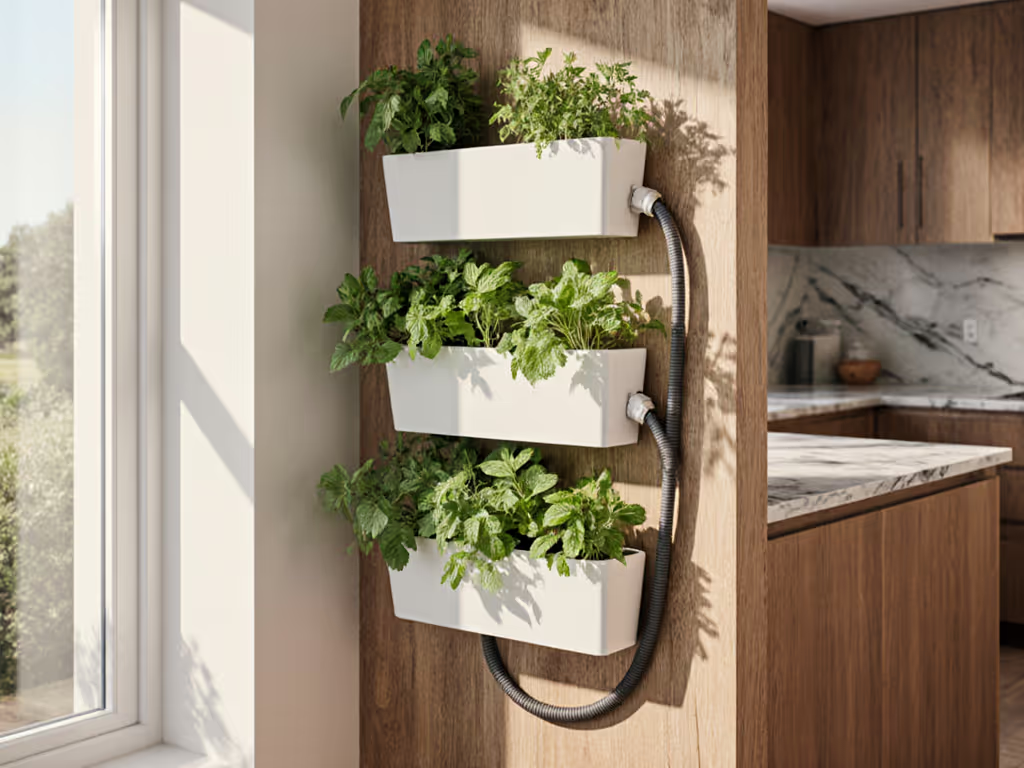
If you want a clean indoor herb wall garden hose setup that doesn't kink, leak, or flood your kitchen, you cannot just grab the best garden water hose off a generic list and hope for the best. The right choice indoors is about low, steady flow, food-safe materials, and a hose that behaves predictably on a vertical run.
Measure flow at the spigot; design back from the task.
Most "best hose" roundups are written for lawns and car washing, not for a basil wall hanging over hardwood floors.[4][9] Indoors, the acceptable failure rate is effectively zero, and that changes the spec.
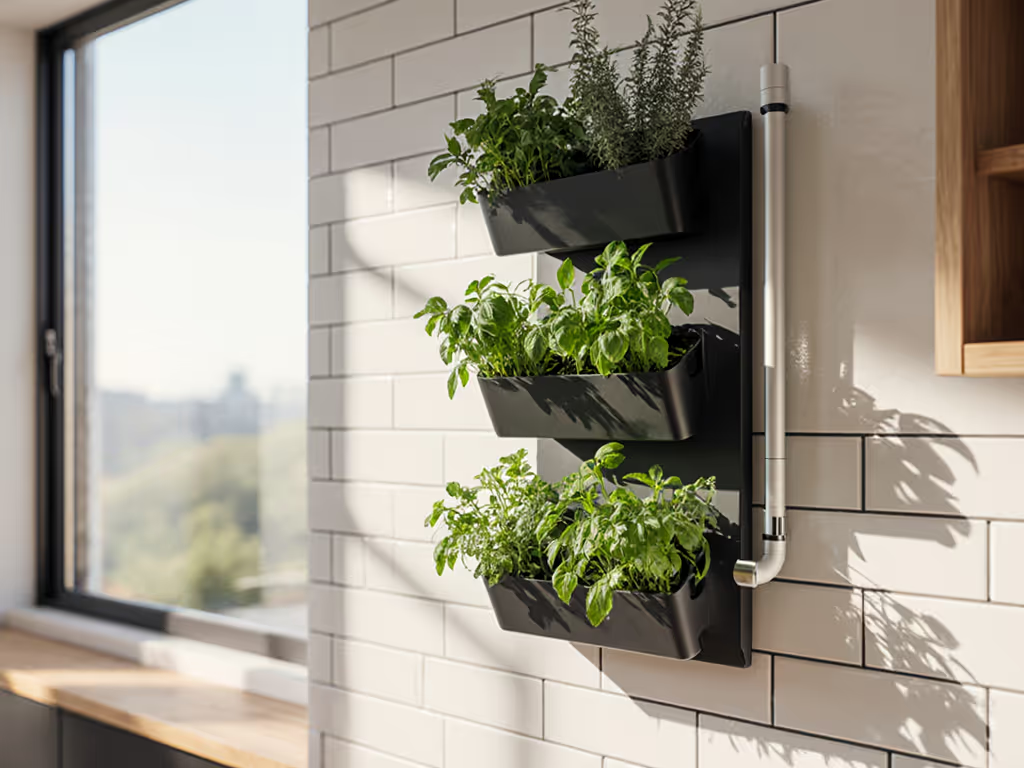
Why Indoor Herb Walls Are Tough on Hoses
Indoor herb walls, hydroponic towers, and vertical planters run at low flow (often 0.1-0.5 gpm per wall) but for long periods. The hose stays pressurized for hours, often 24/7 if you use timers or constant recirculation.
Compared with outdoor use:
- Failure cost is higher: A pinhole outside makes a puddle; inside it can ruin cabinets or drywall.
- Kinks are more likely to be hidden behind cabinets, wall panels, or the frame of an indoor vertical watering system.
- Noise matters: A stiff hose can transmit water hammer and vibration into the wall or cabinet.
- Food safety matters: You're watering edible herbs near food surfaces, not just turf.
Most mass-market hoses are tested and reviewed for yard use (dragging across concrete, UV exposure, sprinkler duty), not for continuous indoor pressure and potable contact.[4][5][9] For certification details and safer indoor options, see our guide to water-safe garden hoses. That's why I treat indoor herb wall supply as its own category of compact indoor watering solutions.
FAQ Deep Dive: Picking the Right Hose for an Indoor Herb Wall
1. What hose diameter and length do I actually need?
Start from the wall's actual demand, not from what's on sale.
For most indoor herb walls and kitchen herb garden hose runs:
- Diameter
- Up to ~25 ft total run: 3/8 in or 1/4 in ID potable hose is usually sufficient for low-flow drip or hydroponic herb wall hose feeds.
- Beyond ~25-30 ft, or if you're feeding multiple walls from one line, step up to 1/2 in ID to keep pressure loss small.
- Length
- Measure the route with all turns and vertical rise included.
- Add 10-15% margin so the hose lays with gentle curves instead of tensioned straight lines (tensioned lines are kink-prone and noisy).
Outdoor hose testing shows that smaller diameters and longer runs noticeably reduce flow at the outlet.[4][5] If you're unsure about run length and pressure drop, use our hose length calculator. Indoors, that translates into uneven watering on the upper rows of a vertical wall. If the top pockets are always dry, suspect undersized or overly long supply.
Rule-of-thumb thresholds for herb walls:
- Single wall, under-sink or adjacent closet: 3/8 in ID, 6-20 ft is typically adequate.
- Two walls on one feed, or a wall plus another device: 1/2 in ID, 10-30 ft to avoid starving the farthest emitters.
2. Which hose materials are safest and most stable indoors?
For an indoor herb wall, I rank hose materials differently than I do for outdoor hoses.
Independent reviews of the best garden hoses consistently find that rubber and hybrid hoses are more durable and kink-resistant than cheap vinyl.[4][5][9] For a deeper breakdown of material trade-offs, see our rubber vs vinyl vs polyurethane. For indoor herb walls, though, weight and flexibility in tight spaces matter just as much as durability.
Common options, from worst to best fit for indoor herb walls:
-
Plain vinyl "utility" hose
-
Pros: Cheap, light.
-
Cons: Stiff in cool rooms, high coil memory, kinks sharply, often not clearly labeled as drinking-water safe.[4][9]
-
Verdict: I don't use this indoors on edibles.
-
Fabric "expandable" hoses
-
Pros: Very compact when depressurized.
-
Cons: Many tests report poor long-term durability, abrasion sensitivity, and higher failure rates under constant pressure.[5][9]
-
Verdict: Fine for quick outdoor tasks; too risky for always-pressurized indoor systems.
-
Standard rubber or hybrid garden hose (5/8 in)
-
Pros: Durable, good kink resistance under normal use.[4][5]
-
Cons: Heavy, overkill diameter for low-flow herb walls, can transmit noise and is hard to route behind cabinets.
-
Verdict: Great outdoors; indoors it's clunky unless runs are very short and fully accessible.
-
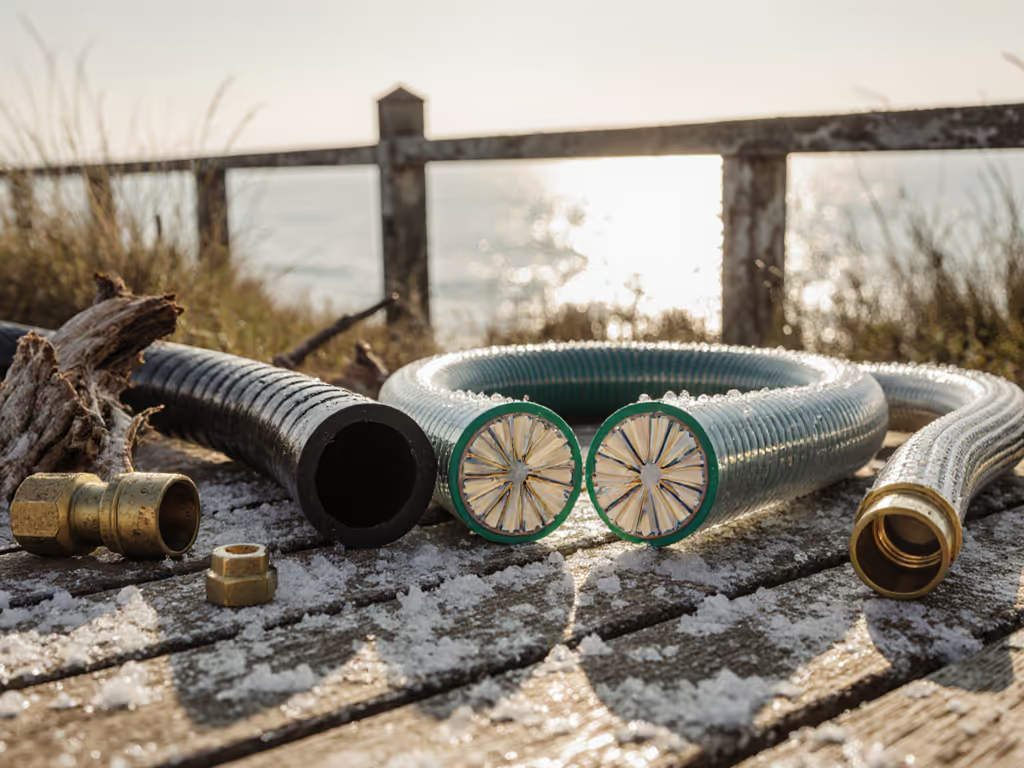
Potable-grade polyurethane or braided PVC (3/8-1/2 in ID)
-
Pros: Commonly available in drinking-water-safe, lead-free formulations; lighter and more flexible; often used on RV and marine potable lines.[4][9]
-
Cons: Needs proper strain relief and support on vertical runs.
-
Verdict: This is my baseline pick for an indoor herb wall garden hose.
For a typical kitchen herb garden hose run, I want:
- Explicit drinking-water-safe labeling (lead-free, phthalate-free, BPA-free).
- Working pressure at least 60-80 psi and burst rating ≥150 psi (anything advertised as 400-600+ psi burst is mostly a marketing number; your house plumbing isn't the limiting factor).[4]
- Smooth inner bore with no fabric jacket to soak up leaks.
3. Is "kink-free" real, or just marketing?
In independent hose tests, virtually every so-called "kink-free" hose still kinked when bent tightly, pulled around obstacles, or used under torsion.[4][5][9] The same physics applies to compact indoor runs.
Instead of chasing a label, treat kink control as a system problem:
- Use the largest practical bend radius: avoid 90° twists right out of the valve.
- Add support clips or P-clamps so the hose is guided, not hanging.
- Avoid forcing the hose through too-small holes in cabinets or framing.
- Minimize torsion: when you install, let the hose naturally relax; don't twist it into place.
I once spent an afternoon chasing a 10-15 psi drop between a source and a distant outlet, only to find a single tight kink hidden under a planter. A small reroute and a better hose fixed a cluster of "mystery" watering issues overnight. Those lessons carry directly into vertical indoor runs.
4. Can I use a standard outdoor garden hose indoors for my herb wall?
Technically yes, but with caveats:
- Size mismatch: A 5/8 in garden hose feeding a tiny wall manifold is bulky and hard to conceal; you gain no benefit at 0.2-0.5 gpm flow rates.
- Food safety: Many general-purpose hoses are not rated for drinking water and may contain lead or plasticizers not meant for frequent ingestion.[4][9]
- Handling: Full-size rubber hoses are heavy and fight you in tight cabinet spaces.[4][5]
If you do repurpose a standard hose, I treat it as acceptable only when:
- It is clearly labeled drinking-water-safe.
- The run is short and fully visible, so you can routinely inspect it.
- The connection points are over a secondary containment (like a tray under a sink base) in case of leaks.
For most installations, a purpose-selected 3/8-1/2 in potable hose is safer and cleaner than trying to shoehorn the best garden water hose you already own into an indoor vertical watering system.
5. What's different for a hydroponic herb wall hose?
A hydroponic herb wall hose usually does one of two jobs:
- Feed fresh water/nutrient solution from a tap or reservoir up to the top of the wall.
- Return solution from the wall back to a reservoir.
Functionally, that means:
- Constant or frequent flow: More time under pressure than typical outdoor use.
- Elevated vulnerability: A pinhole in the supply line is a continuous leak.
For hydroponic runs, I tighten specs:
- Use potable-grade hose even if nutrients are added downstream.
- Target braided or reinforced construction to reduce bulging on vertical runs.
- Provide strain relief at the top wall manifold to avoid the hose weight pulling on fittings.
Where flexible hose transitions to rigid manifolds or barbed fittings, I test for flow loss and leaks as a complete loop, not as isolated parts. That's the system-first stack mindset: the weakest link sets your reliability ceiling.
6. How do I prevent leaks at indoor connections?
Most leaks in indoor herb wall setups are not in the hose itself, but at:
- Faucet adapters.
- Quick-connect couplers.
- Under-sink tee fittings.
- Push-to-connect or barbed transitions.
To minimize leak risk:
- Use full-bore fittings that match the hose ID; avoid skinny throat adapters that throttle flow.
- Prefer metal (brass or stainless) over thin plastic in high-stress spots.
- Choose O-ring sealed connections instead of relying only on tapered threads.
- Keep spare washers and O-rings rated for potable water on hand.
Testing of hoses and reels repeatedly shows that connections, not hose walls, are the dominant failure point over time.[4][8] Indoors, every threaded or quick-connect joint over finished surfaces deserves the same attention you'd give a supply line to a dishwasher.
7. How much pressure can an indoor herb wall hose safely handle?
Most residential plumbing systems run between 40-80 psi, with 50-60 psi common at indoor taps. If your tap pressure is high or fluctuates, add a garden hose pressure regulator to protect emitters and stabilize flow.
Quality garden hoses are often rated for 150-400+ psi burst, but burst ratings in marketing do not always align with real-world durability.[4][9] For an indoor herb wall garden hose, I use these thresholds:
- Working pressure: At least 2× your measured line pressure; if your home runs at 60 psi, a hose with 120 psi working rating is my minimum.
- Burst pressure: At least 3× your measured line pressure; in practice, that usually means ≥150 psi.
Once you've cleared those basics, higher numbers add less value than:
- Better material (e.g., polyurethane vs cheap vinyl).[4][9]
- Better reinforcement (braided vs non-reinforced).[4]
- Better connectors and strain relief.
Again:
Measure flow at the spigot; design back from the task.
I always measure actual line pressure before finalizing a design. A $20 gauge on the tap tells you more than three pages of marketing.
8. Are coiled hoses good compact indoor watering solutions?
Coiled hoses look attractive for small spaces because they retract neatly, but testing and real-world use show trade-offs:
- They tend to have strong coil memory, which means they can tug on fittings and wall manifolds.
- Their tighter bends can increase pressure loss and promote kinks at the ends where the coil transitions to straight.
- Cheaper coils are often vinyl-based, with the same stiffness and kink problems as straight vinyl hoses.[5][9]
For an indoor herb wall, I only consider a coiled hose when:
- The run is fully visible, so you can see and correct stress points.
- The hose is explicitly potable-grade.
- The coil is used mainly near the source (e.g., a sink) and transitions to a more stable straight run before entering the wall system.
In many kitchens, a short, straight, flexible 3/8 in potable hose routed cleanly behind cabinets beats a coil on both flow and reliability.
9. How do I connect to a kitchen faucet or under-sink line safely?
For a temporary connection (e.g., rolling herb wall or occasional use):
- Use a faucet-to-hose adapter sized to your aerator threads.
- Step immediately into potable-grade hose.
- Relieve strain with a small loop and clip so the hose's weight is not hanging off the faucet neck.
For a permanent or semi-permanent connection:
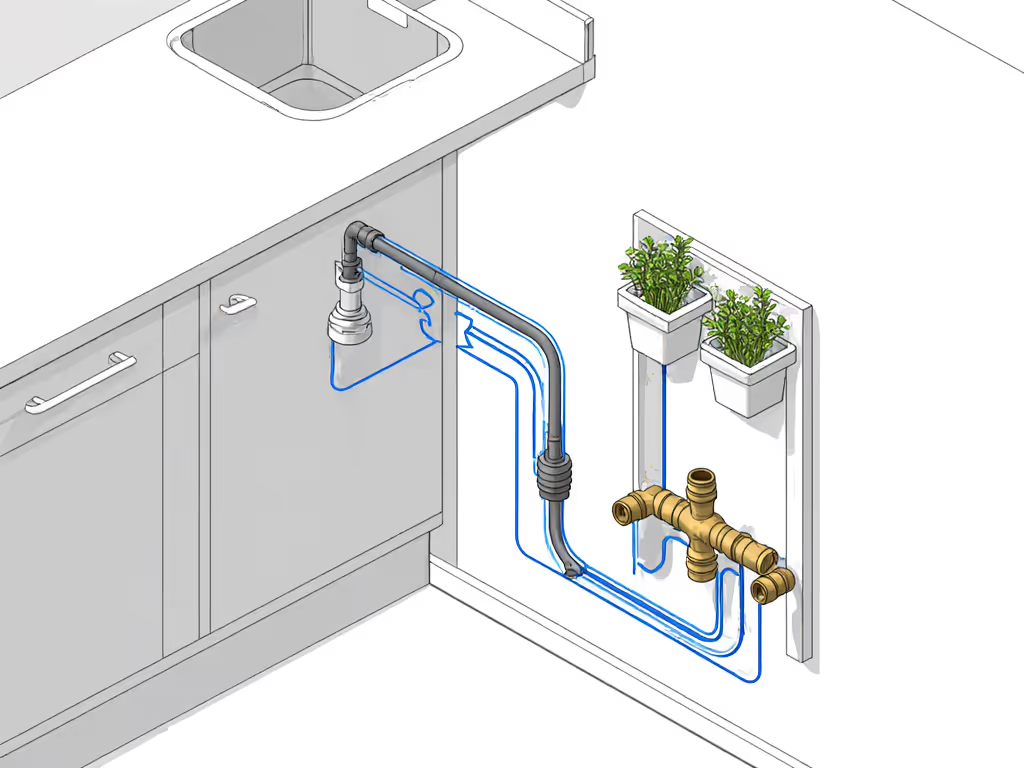
- Tee off the under-sink cold line with a plumbing tee and a shutoff valve.
- Add a backflow preventer if local code or common sense suggests it (especially with hydroponic nutrient loops).
- Use fixed brackets or clamps to guide the hose along the cabinet back and up into the wall system.
Regardless of method, I pressure-test the full run:
- Pressurize.
- Hold for at least 30 minutes with all outlets closed.
- Wipe each joint with a dry tissue to detect weeping leaks.
This approach mirrors how professional hose and reel tests evaluate connection integrity over time, not just at first pressurization.[4][8]
10. What does a "good" indoor herb wall hose setup look like in practice?
A stable, low-maintenance indoor system typically has:
- Source: Under-sink cold line with its own shutoff valve.
- Primary feed hose: 3/8-1/2 in ID, potable-grade polyurethane or braided PVC, clearly supported along its path.
- Transitions: Minimal adapters; where needed, full-bore brass or stainless with O-ring seals.
- Wall interface: A small manifold or header with easy access for inspection.
- Serviceability: Enough slack and union fittings to replace the hose without tearing apart cabinetry.
When I build test rigs for indoor vertical watering system prototypes, I treat the hose, fittings, valves, and manifolds as one system-first stack. To maintain water quality in indoor systems, follow our biofilm removal guide. Any part that adds turbulence, throttles flow, or introduces a leak risk gets flagged, even if the hose itself is perfect.
Where to Go Next: Simple Audit for Your Herb Wall Hose
Use this quick audit to decide whether to keep, upgrade, or redesign your current or planned setup:
- Check safety
- Is every wetted component rated drinking-water-safe? If not, that's the first replacement.
- Measure your system
- Measure pressure at the source.
- Estimate flow at the wall by timing how long it takes to fill a measured container.
- Inspect routing
- Identify any sharp bends, hidden kinks, or points where the hose rubs against sharp edges.
- Add clips or reroute to increase bend radius.
- Evaluate diameter and length
- If upper pockets of the wall are under-watered, consider larger hose ID or shorter run.
- Test under real conditions
- Run the system as it will be used (timers, recirculation, etc.) and inspect all joints for leaks after 30-60 minutes.
From there, you can experiment with one variable at a time (diameter, material, routing) until your indoor herb wall runs quietly, evenly, and without surprises. That's the point where the hose disappears from your mental to-do list and just does its job season after season.
Related Articles