Coastal Garden Hose Materials Compared: Durable, Kink-Free
By Priya Nandakumar • 21st May
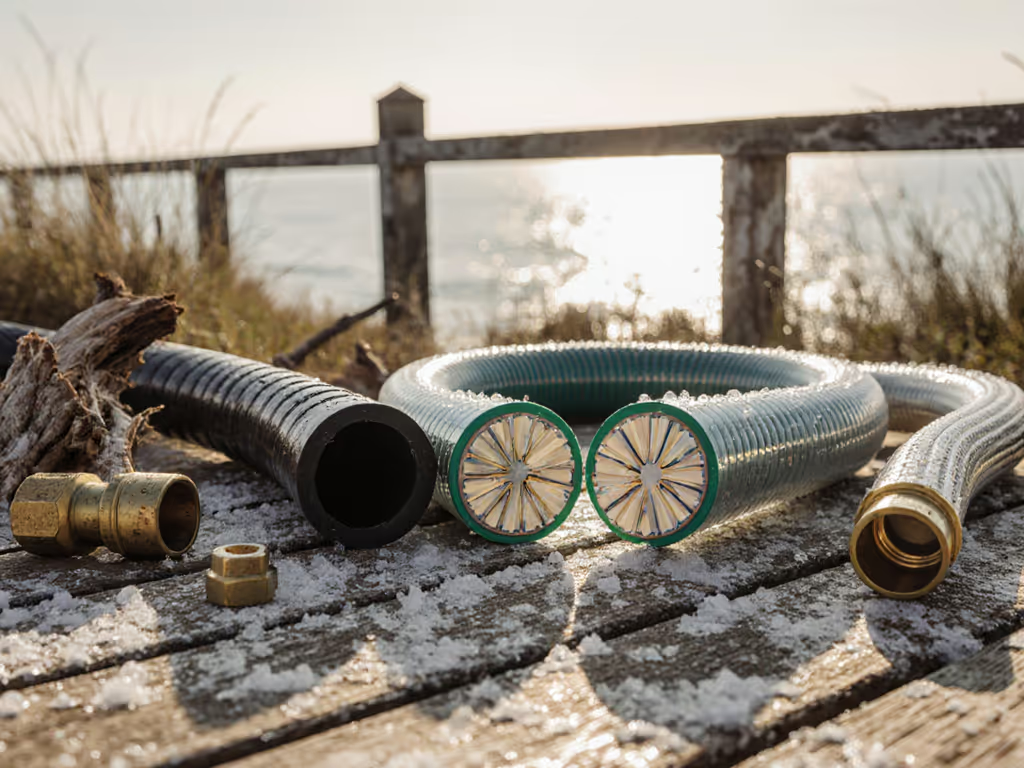
If you live near salt air, fog, or sea breezes, coastal garden hose materials matter more than brand logos or color. The best garden water hose in a coastal climate is the one that holds pressure, resists UV and salt, doesn't kink under real use, and doesn't leach junk into your soil or pets' bowls.
Measure flow at the spigot; design back from the task.
This FAQ walks through the data and trade-offs so you can choose a hose that survives coastal humidity, salt spray, and sun without becoming a cracked, leaky tangle in two seasons. If you need potable water on docks or boats, see our marine drinking water hoses tested for salt resistance and NSF certifications.
Quick Answer: What Hose Material Wins at the Coast?
If you want the short version before the deeper FAQs:
Best overall for most coastal homeowners (yards, beds, car wash):
- Thick-wall polyurethane or hybrid polymer hose (5/8" ID) with lead-free brass or stainless steel fittings, rated at least 150 PSI working / 400+ PSI burst, UV-resistant jacket.
Best for heavy, daily use or commercial / "professional garden hose" needs:
- EPDM or rubber "commercial" hose (5/8" or 3/4" ID) with solid brass or stainless, if you can tolerate the weight.
Best for potable / RV / boat in a marine environment:
- Drinking-water-safe polyurethane hose (NSF/ANSI 61 or similar) with stainless or truly lead-free brass fittings.
Usually poor choices in coastal environments:
- Thin PVC/vinyl hoses: fast UV cracking, kinking, and higher risk of lead/phthalates.
- Fabric expandable hoses left outdoors: UV and abrasion kill them quickly around sand and shells.
The rest of this article unpacks the "why" behind those calls. For a broader, climate-by-climate breakdown of material performance, see our rubber vs vinyl garden hose durability by climate comparison.
FAQ Deep Dive
1. What actually kills hoses in coastal climates?
From a test-bench standpoint, coastal hoses tend to fail from a few predictable stressors:
- UV and heat cycling
- Dark decks, docks, and pavers can hit 50-70°C (120-160°F) surface temps in summer sun.
- PVC/vinyl softens and then embrittles; micro-cracks appear at kinks and loops.
- Salt and corrosion at the fittings
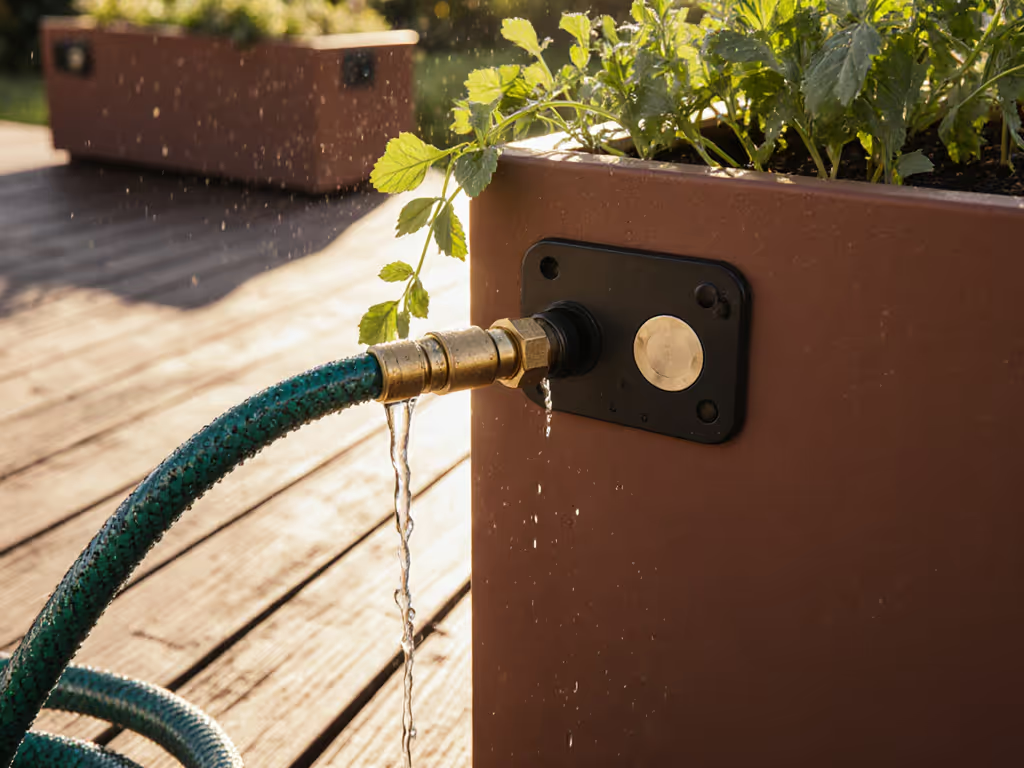
- Salt-laden air condenses on metal. Cheap "brass" (often brass-plated zinc) and pot-metal fittings pit, seize, and crack.
- Galvanic corrosion accelerates if your spigot or boat hardware is a different alloy than the hose coupler.
- Coastal humidity
- Constant dampness promotes mold on the jacket and corrosion on internal springs and shutoffs.
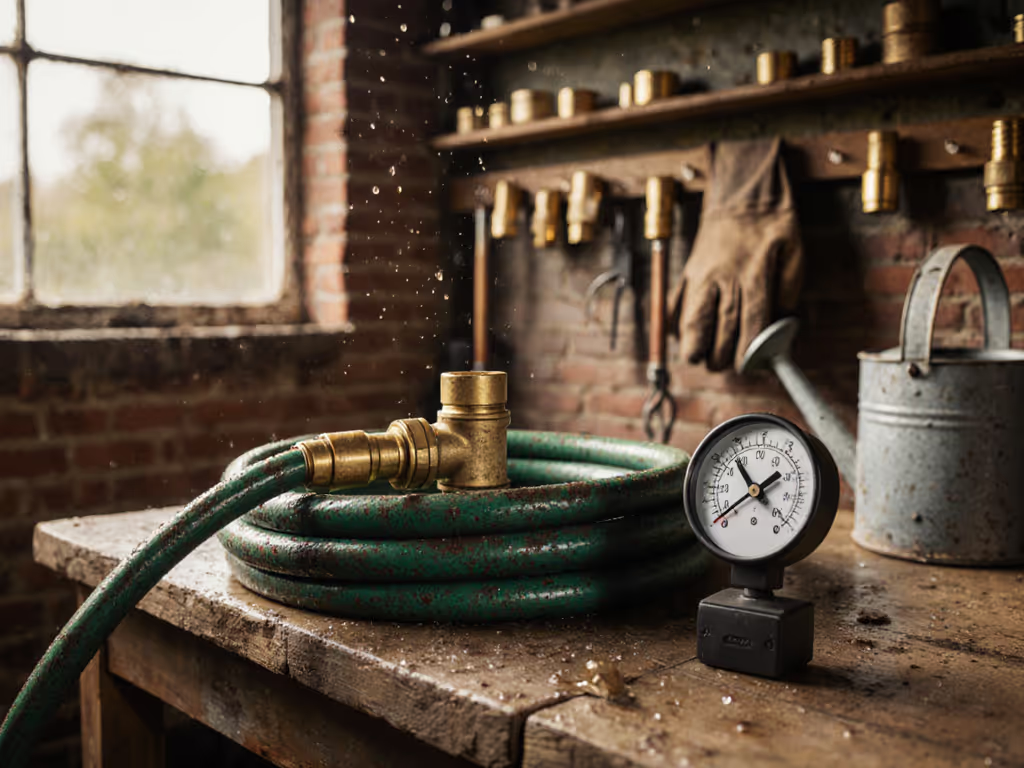
- Hoses stored in tight coils never fully dry, so steel components rust from the inside.
- Kinks and coil memory
- Lightweight hoses that ship in tight coils develop "memory." In the field, they kink at the same points every time you pull around a corner or under a planter.
- Under flow (say 3-6 GPM typical for many homes), those kinks cause major pressure drops and eventually burst.
- Overpressure and heat
- Many homes see static pressures of 70-90 PSI. If you leave a hose closed at the nozzle in full sun, water expands and pressure spikes. Cheap hoses rated at 200 PSI "burst" in lab conditions fail much sooner in real, hot, kinked coils.
When I test coastal setups, hoses that survive 5+ seasons typically share three traits:
- Thicker walls (kink resistance and burst strength)
- UV-stable, non-PVC jacket
- Corrosion-resistant hose fittings (solid brass or stainless) with full-bore flow
2. How do common hose materials compare for marine environment hose durability?
Let's compare the main materials you'll see on shelves.
PVC / Vinyl Hoses
- Pros: Lowest cost, very light.
- Cons:
- Poor UV resistance; surface cracks often within 1-3 seasons in strong sun.
- High "coil memory" and kinking, especially in cool mornings.
- Often contain PVC with plasticizers; independent testing has found elevated lead and phthalates in many PVC hoses, especially older or cheaper models.
- Coastal verdict: Fail for long-term outdoor duty. OK as a short, temporary hose stored indoors, but not a system-first stack component.
Rubber (Natural / EPDM / Synthetic Blends)
- Pros:
- Excellent abrasion and UV resistance; can easily hit 10+ years if stored off the ground and out of constant sun.
- Flexible across a wide temperature range.
- Heavier walls = strong kink resistance and high burst ratings.
- Cons:
- Heavy. A 3/4" x 100 ft commercial rubber hose can exceed 20 lb; this matters on docks, stairs, and for older users.
- Can scuff siding or deck rails if dragged dry.
- Coastal verdict: Excellent for professional garden hose use, frequent watering, or rugged dock duty if you can manage the weight.
Polyurethane (PU)
- Pros:
- Very good abrasion resistance; jacket doesn't crack like PVC under UV.
- Can be formulated as drinking-water-safe; independent lab work has found top PU hoses marketed as potable to be free of significant lead and common heavy metals in hose walls.
- Lighter than rubber, but can still have thick walls for kink resistance.
- Cons:
- Cheap, thin-wall PU hoses kink similarly to vinyl; material alone doesn't guarantee performance.
- Stiffness can increase in cold weather, though that's less critical in mild coastal climates.
- Coastal verdict: Top choice for most homeowners when combined with good fittings. Strong candidate for "best garden water hose" in coastal yards.
Hybrid Polymer (Multi-layer)
- Pros:
- Combines PU, rubber-like elastomers, and reinforcement layers.
- Good balance of flexibility, kink resistance, and UV durability.
- Often marketed as "contractor" or "professional garden hose" yet lighter than pure rubber.
- Cons:
- Performance is heavily brand-dependent; you want clearly stated PSI ratings and visible reinforcement.
- Coastal verdict: Very good, especially if you need a hose that lays flat, doesn't fight you, and stays stable on reels.
Fabric Expandable Hoses
- Pros: Feather-light, easy for seniors to drag and coil.
- Cons:
- Outer fabric sleeve is highly vulnerable to UV, sand abrasion, and shells.
- Rapid degradation when left pressurized or in sun.
- Tiny inner tubes and restrictions mean lower flow and higher friction loss.
- Coastal verdict: Short-life convenience only. Use as a secondary hose that lives in a shaded bin, not your main coastal workhorse.
Stainless "Armor" Hoses (Metal-jacketed)
- Pros:
- Very abrasion-resistant; good against chewing pets or sharp edges.
- Stainless shell handles UV and salt spray well.
- Cons:
- Inner core is still usually a small-diameter plastic tube, so flow capacity is limited.
- Can be stiff and noisy over hard surfaces.
- Coastal verdict: Niche solution where physical damage is the main risk; not my first pick when pressure stability and flow are the priority.
For coastal durability, thick-wall polyurethane or hybrid polymer with solid metal fittings usually beats PVC on every metric that matters.
3. How does salt air affect hose fittings, and should I choose brass or stainless?
Your hose is only as reliable as the joints at the spigot, reel, and nozzle. In coastal testing, failures cluster at:
- Couplers seizing to the spigot
- Splitters cracking
- Thin-threaded quick-connects snapping
Brass fittings
- Solid brass (lead-free) performs well in light to moderate salt air (typical suburban coastal yards).
- Cheaper alloys with high zinc content can suffer dezincification, leaving a crumbly, pinkish surface over 3-5 years of coastal exposure.
Stainless steel fittings
- 304 stainless is adequate for many coastal yards.
- 316 stainless is the marine-grade benchmark where there's direct, frequent salt spray (docks, boats).
- Significantly more resistant to pitting and seizing than cheap brass.
Practical guidance:
- Within 1-2 blocks of the ocean / on docks: favor stainless every time you can.
- 1-10 miles inland with occasional salt fog: high-quality solid brass or stainless both work; rinse fittings a few times each season.
- Avoid pot metal or aluminum splitters; they often crack or fuse to the spigot.
Look for fittings that are:
- Full-bore (no sudden ID shrink from 5/8" hose to a 1/4" choke)
- Crimped, not swaged in a thin band that cuts into the hose
- Marked as lead-free for potable/edible use
4. Which hoses really are "kink-free" in coastal use?
"Kink-free" on a box usually means "didn't kink in our single gentle test." Real yards involve:
- 90° turns around raised beds
- Hoses dragged under grills and planters
- Partial coils on reels
Kink resistance is a function of:
- Wall thickness and reinforcement - thicker walls and a strong braid resist collapse.
- Material stiffness - too soft and it folds; too rigid and it holds memory from coils.
- Diameter - larger IDs are structurally harder to kink, all else equal.
From bench tests:
- Thin, cheap PVC hoses commonly kink at <10-15 N of lateral force.
- Quality hybrid/polyurethane hoses with reinforcement often require 2-3x more force to form a hard-flow-stopping kink.
Signs a hose will behave better:
- Listed as 5/8" ID with clearly stated reinforcement layer.
- Advertised minimum bend radius or kinking tests (rare, but a good sign when present).
- Thicker, slightly heavier feel compared with discount hoses of the same length.
If you use a reel, choose hoses labeled "flexible to radius X" or explicitly "reel-compatible." This minimizes coil memory. My own kink source once turned out to be a tight loop buried under a patio planter; swapping to a thicker 5/8" hose and a full-flow Y recovered ~12 PSI at the nozzle.
5. What hose diameter and length should I run for coastal yards?
Coastal homes frequently have long, narrow lots, plus side yards running to the street or dunes. That tempts people into buying a single 100-150 ft hose and calling it done. The flow penalty is real.
Simplified numbers (assuming ~60-70 PSI at the spigot and typical garden flows):
- At 4 GPM through 5/8" hose:
- 50 ft: ~3-4 PSI loss
- 100 ft: ~8-10 PSI loss
- At 4 GPM through 1/2" hose:
- 50 ft: ~10-13 PSI loss
- 100 ft: 20+ PSI loss
For sprinklers, pressure nozzles, and pressure washers, those extra 10-20 PSI drops matter.
Practical diameter rules:
- 1/2": only for short runs (<50 ft) and light hand watering.
- 5/8": best general-purpose choice; plenty of flow for most yards and tools.
- 3/4": use when total run exceeds 100 ft or you're feeding multiple sprinklers or high-flow devices from one line.
Length selection for coastal yards:
- Measure the actual run to your farthest task (around corners, not straight-line).
- Add ~6 ft for vertical drops/rises and another ~20% for obstacles and routing slack, as one manufacturer-backed guide recommends.
- If you're torn between two lengths, size up slightly rather than daisy-chaining short hoses; every extra coupling is another leak and choke point.
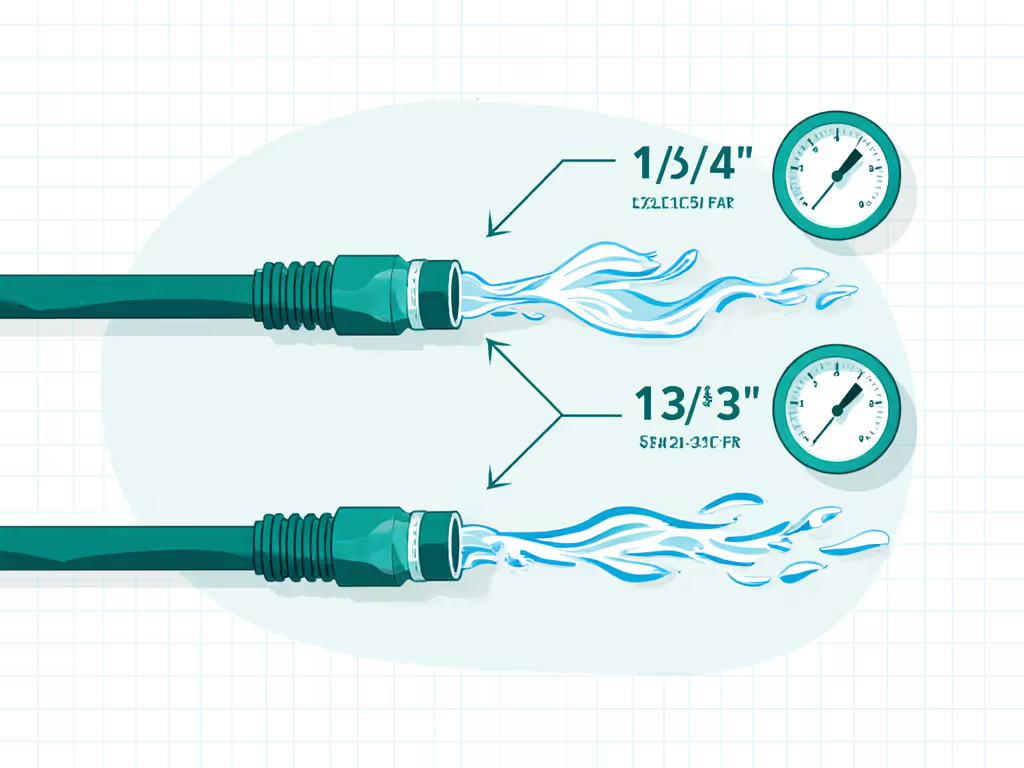
For system design, it's often better to run two 50 ft hoses from separate spigots than one 100 ft line, if your house plumbing allows it. For choosing 1/2, 5/8, or 3/4 inch lines based on garden size, use our garden hose diameter guide with flow calculations.
6. Is a "professional garden hose" worth it in a marine environment?
"Professional" or "contractor-grade" is marketing language, but there are measurable differences when you look at the spec sheet:
Typical pro-grade hose characteristics:
- Material: EPDM/rubber or heavy-duty hybrid polymer
- Working pressure: ≥ 150 PSI
- Burst pressure: ≥ 400 PSI
- Fittings: solid, machined brass or stainless, often with bend restrictors
- Reinforcement: visible braided layer
In coastal conditions, stepping up to this class is worth it if:
- You water 3-7 days a week, year-round.
- You're feeding sprinklers, pressure washers, or multi-zone irrigation where flow stability matters.
- The hose will see driveway/sidewalk abrasion and occasional vehicle crossings.
If you only pull a hose out on weekends for patio plants, a mid-grade polyurethane or hybrid hose is adequate. But if you're near the ocean and expect a hose to live outside and stay pressurized often, a professional garden hose is usually cheaper over a 5-10 year horizon than replacing a bargain hose every 1-2 seasons.
7. What's safest for veggies, kids, and pets in coastal gardens?
Coastal gardeners often grow high-value edibles and let kids or dogs drink from the hose. Material safety matters.
Independent lab work (including non-profit testing summarized by health-focused organizations) has found:
- Many PVC hoses contained elevated lead and phthalates, sometimes in the tens of thousands of ppm for lead in certain components.
- Hoses explicitly labeled "drinking water safe" and made of polyurethane often showed no detectable heavy metals in the polymer itself.
- Some hoses claimed "lead-free couplings," but other parts still contained lead.
Practical safety guidelines:
- Avoid PVC/vinyl hoses for any use involving food, pets, or human drinking, especially if not clearly labeled lead-free.
- Choose polyurethane or rubber hoses labeled "drinking water safe", ideally with a certification like NSF/ANSI 61.
- Ensure "lead-free" applies to the whole hose, not just the coupling.
- In any material, flush standing water before use... contaminants concentrate in water sitting hot in the hose.
These steps matter in coastal zones because sun-heated hoses reach higher temps, which can increase leaching rates. If you grow edibles, read our drinking-water-safe hose guide for test data and safe picks.
8. How should I store a hose in coastal humidity to actually get 5-10 years out of it?
Storage and habits often matter as much as material choice. A covered, corrosion-resistant hose reel and storage setup also shields gear from salt and UV.
Good practices for coastal hose longevity:
- Keep it out of direct all-day sun
- Use a covered reel, shaded side of the house, or under a deck.
- Even UV-resistant materials last longer when shielded.
- Allow drainage and drying
- Store hoses on a large-radius hanger (at least 12-18" diameter) so the loops aren't tight.
- Avoid leaving water trapped in low spots where algae and corrosion thrive.
- Depressurize after use
- Close the spigot, open the nozzle, and let the hose relax.
- This reduces stress on crimps, fittings, and the hose wall during hot periods.
- Rinse salt off fittings periodically
- A quick fresh-water rinse of the spigot end and any metal parts every few weeks goes a long way near the ocean.
- Winterize in freeze-prone coastal climates
- Disconnect, fully drain, and store hoses where they won't freeze full of water.
- Pay special attention to reels, which often trap water and split the last loop of hose.
Taken together, these habits can extend a good polyurethane or rubber hose from a 3-4 year tool to a 7-10 year component in your system-first stack.
9. What's a simple decision path for coastal garden hose materials?
Use this quick filter based on your setting.
A. On a dock, marina, or within ~1-2 blocks of open saltwater
- Material:
- Primary: drinking-water-safe polyurethane or heavy hybrid polymer.
- For heavy-duty: EPDM/rubber commercial hose.
- Fittings:
- Prefer 316 or 304 stainless; otherwise, top-tier lead-free brass.
- Diameter: 5/8" standard; 3/4" if feeding multiple devices or long runs.
B. Coastal suburban yard (1-10 miles from the ocean)
- Material:
- Thick-wall polyurethane or hybrid polymer for most users.
- Rubber if you want max durability and don't mind weight.
- Fittings:
- Solid lead-free brass or stainless with full-bore passages.
- Diameter: 5/8" for most; 3/4" if total hose length > 100 ft feeding sprinklers.
C. Light patio use / balcony in a coastal townhome
- Material:
- Compact polyurethane hose or a short, high-quality hybrid hose.
- Fittings:
- Brass is usually sufficient.
- Diameter & length: 1/2" or 5/8", <50 ft. Aim for easy handling over max flow.
D. RV / boat potable use near the coast
- Material:
- Certified drinking-water-safe polyurethane only.
- Fittings:
- Stainless or certified lead-free brass.
- Habits:
- Always drain and store out of sun when moving; don't leave potable hoses on docks.
10. How do I make sure the hose works as part of my whole system?
A hose isn't an isolated purchase. It's one link in your system-first stack: spigot -> hose -> splitters/timers -> nozzles/sprinklers -> soil.
To verify that the hose you choose is doing its job:
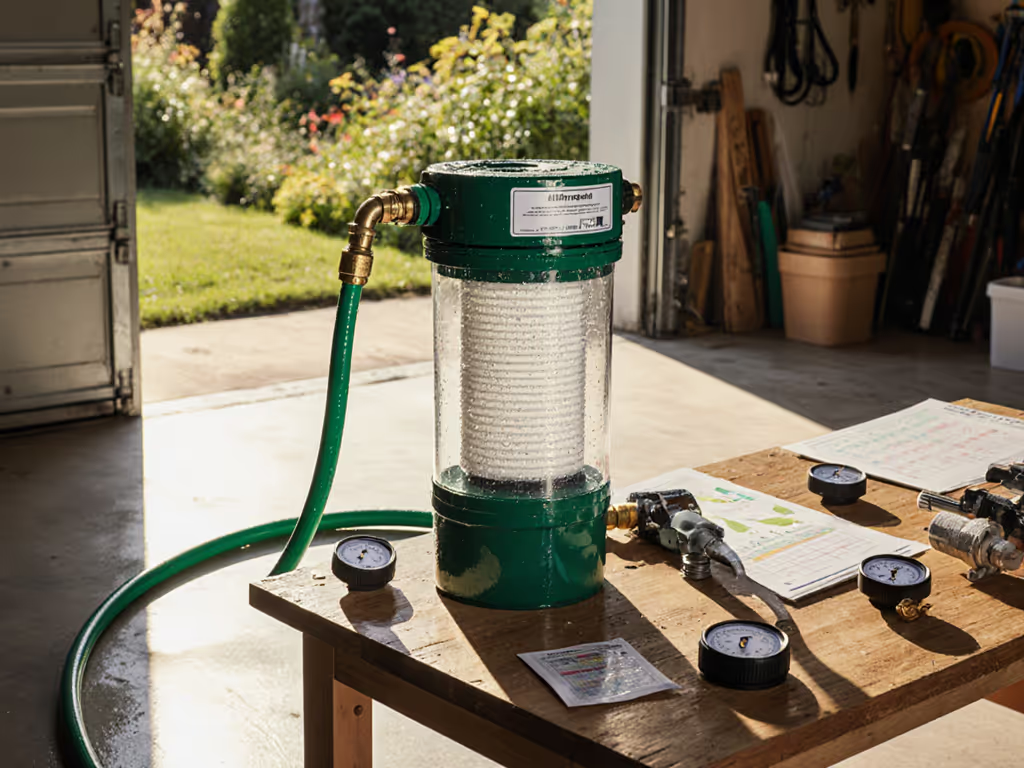
- Measure at the spigot
- Use a simple pressure gauge on a hose-thread adapter.
- Note your static pressure and a rough flow rate (e.g., how many seconds to fill a 5-gallon bucket).
- Check at the task end
- Repeat bucket timing at the furthest nozzle.
- If you see a >20-25% drop in flow or >15 PSI loss, look for bottlenecks: undersized hose, restrictive Y-splitter, or kink.
- Eliminate choke points
- Replace narrow Y-splitters and timers with full-flow versions.
- Use consistent hose diameter; avoid stepping down to 1/2" for long runs.
- Standardize fittings
- Choose one ecosystem of quick-connects or couplers, and stick with it.
- Ensure internal passages in connectors are as wide as the hose ID.
Once you've done this once - measuring at the spigot and at your worst-case nozzle - it becomes straightforward to judge whether a new hose or fitting is helping or hurting.
Measure flow at the spigot; design back from the task.
That single habit keeps your coastal hose setup honest.
Where to Go Next
If you've read this far, you're not looking for a decorative coil of green plastic - you want a system that delivers stable pressure, resists salt and sun, and doesn't kink when you're in a hurry.
Next steps:
- Map your runs. Sketch your yard or dock, mark distances and elevation changes.
- Measure your spigot. Note pressure and fill time for a 5-gallon bucket.
- Choose material + fittings from the decision path above.
- Standardize diameters and fittings for future add-ons (reels, quick-connects, timers).
From there you can evaluate reels, quick-connects, and irrigation add-ons with the same lens: does this preserve or choke flow, and will it survive salt, UV, and humidity along with the hose? Answer that, and you'll only have to build this coastal hose system once.
Related Articles