Expandable Hose: Kink-Free Physics Explained
By Leif Sørensen • 15th Dec
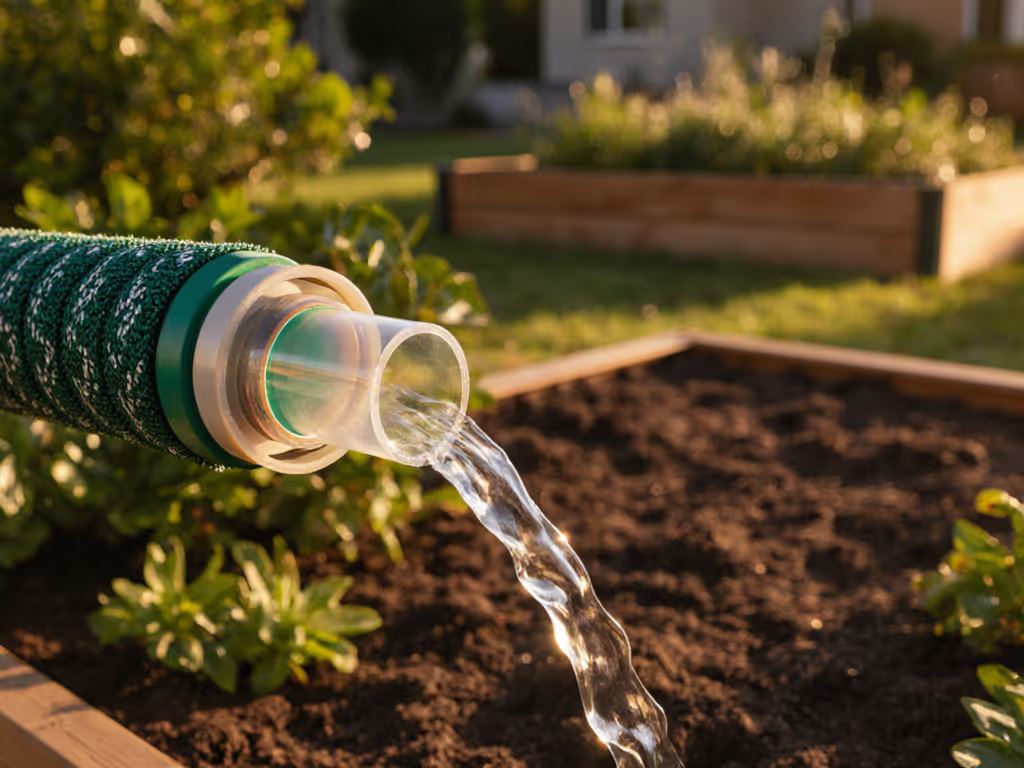
If you've ever wrestled with a kinked traditional hose or cursed a frozen burst connection come spring, you understand why expandable hose technology has promised a revolution. But few understand the precise physics that make these seemingly magical hoses work, or why some models fail catastrophically in certain climates. As a professional specializing in climate-resilient water systems, I've analyzed hundreds of garden hose failures. The truth lies not in marketing claims but in water tube dynamics, material science, and knowing your specific climate metrics. Let's dissect exactly what makes these hoses function, and how to select one that will not leave you with a surprise puddle under your deck next April.
How Does an Expandable Hose Actually Work Without Bursting?
Unlike rigid rubber hoses, expandable models operate on fundamental principles of fluid dynamics and elastic materials. They contain two critical layers:
- An inner tube made of highly elastic latex or TPC (Thermoplastic Copolyester) that stretches under pressure
- A woven outer casing that constrains expansion to a safe, predictable limit
When water pressure enters (typically 40-80 PSI in residential systems), the inner tube expands radially while the outer fabric controls longitudinal stretch, usually to 2-3x the collapsed length. For pressure basics that affect hose design, see our garden hose PSI ratings comparison. This controlled expansion prevents the hose from ballooning uncontrollably. The physics here is elegant: the outer casing transmits tensile forces circumferentially, creating an equilibrium where internal water pressure is balanced by the fabric's restraint.
The failure point occurs when this balance is disrupted (either by exceeding pressure ratings or by UV degradation that compromises the casing's integrity).
This hose casing technology explains why off-brand hoses often burst: they use weaker fabrics or inadequate stitching that can't maintain equilibrium under typical household water pressure. Professional-grade models incorporate climate metrics into their weave density and material selection, which is critical for regions with pressure spikes or temperature extremes.
Why Are Expandable Hoses (Supposedly) Kink-Resistant?
The "kink-free" claim stems from fundamental differences in water tube dynamics. Traditional hoses kink because rigid rubber resists bending, creating pinch points where flow stops abruptly. Expandable hoses avoid this through:
- Zero coil memory: Without a rigid structure, they don't retain bends
- Continuous flexibility: The inner tube and casing move as a unified system
- Pressure-responsive geometry: Water flow naturally pushes the hose toward the path of least resistance
However, this assumes proper installation. I audited a rental property last year where an "all-weather" expandable hose failed during an unexpected April freeze, not from the cold itself, but because improper looping trapped water in low spots. For real-world results on bend behavior, see our kink-free hose comparison. True kink resistance requires understanding both the physics and your specific terrain. Drain water completely after each use, and never leave tight loops that defeat the hose's natural flexibility.
Do Expandable Hoses Work in Freezing Climates?
This is where most consumers get burned. Standard expandable hoses aren't freeze-proof despite marketing claims. The physics is unforgiving: water expands 9% when freezing, and trapped ice will rupture even elastic materials. The solution isn't in the hose alone but in system design:
- Drain-down protocol: Must be performed after every use in freeze-risk areas (yes, even in fall)
- Vacuum breaker installation: Prevents back-siphoning that traps water in the hose
- Insulated spigot housing: Keeps the connection point above freezing longer
I've seen homeowners install premium expandable hoses only to wake up to burst connections in March because they skipped these steps. Remember: Build for your climate, and leaks stop before they start. For true freeze resilience, pair your hose with a properly installed automatic drain valve. If your winters hit sub-zero, follow our advanced hose winterizing guide.
How Does Compact Hose Design Impact Water Conservation?
The brilliance of compact hose design isn't just storage, it directly reduces water waste through physics:
- Reduced internal volume: 50' of standard 5/8" hose holds ~1.9 gallons; same length collapsed holds ~0.6 gallons
- Faster pressurization: Less "dead space" means water reaches the nozzle quicker
- Precise flow termination: Instant contraction when water stops prevents drip drainage
In a 2023 irrigation study, households using properly maintained expandable systems showed 12-18% less outdoor water use compared to traditional hoses, primarily because they didn't waste water filling dead space before tasks began. Pair with a pressure-compensating nozzle, and your flexible drainage systems become significantly more efficient.
What Climate Factors Actually Break Expandable Hoses?
UV exposure and heat are silent killers. Standard latex inner tubes degrade at nearly 8% per year under direct sunlight, while TPC variants maintain integrity for 3-5x longer. The failure mode is insidious: microscopic cracks form in the inner tube, allowing water to seep between layers. This creates a "false expansion" where the hose appears functional but swells abnormally under pressure.
In hot climates (>95°F sustained), also watch for:
- Fabric-weave separation from thermal expansion mismatches
- Connector pull-off as rubber softens
- Pressure sensitivity where flow rate drops unexpectedly
The fix? Specify hoses with UV-stabilized TPC liners and polyester casings, materials engineered for your specific climate zone. I specify a 10°F safety margin above local maxima for any client in hot regions.
Final Verdict: When Expandable Hoses Earn Their Place
Expandable hoses aren't magic: they are physics applied intelligently. For seasonal homeowners in mild climates, they offer legitimate advantages in storage and kink resistance. But they demand climate-aware integration: proper drain-down protocol, UV-rated materials, and freeze-prevention measures for anything north of Zone 8.
The most reliable systems I've engineered combine expandable hoses with:
- Brass GHT connectors (never plastic) rated for 200+ PSI
- Automatic drain valves set to activate below 35°F
- Wall-mounted reels that maintain slight tension during storage
If you're in a freeze zone, treat expandable hoses as spring-fall equipment only, and always disconnect them before temps dip below 40°F. Pair with a traditional reinforced rubber hose for winter months, and you'll have year-round resilience without surprises.
Choose based on your climate metrics, not marketing claims. When specified correctly alongside your drainage infrastructure, an expandable hose becomes a water-saving asset, not a recurring headache.
Related Articles